

calibusje
Super Poster
VIP Member
- Messages
- 1,563
- Vehicle
- T6.1 Coast 150
Some reading material for those interested.
Westfalia became known worldwide in the 1960s as an iconic brand of campervans. But from the 1990s onwards, things went downhill as a result of management errors. It could be called a thriller. But let us start at the beginning.The beginning
Johann Bernhard Knöbel had a forge in Wiedenbrück from 1844 and focused on building coaches and wagons. He bequeathed his small business to his two sons 43 years later. To preempt disagreements, he divided it up in advance: Wilhelm received the wagon building department and Franz, who was thirteen years younger, the paint shop and the upholstery department. They did not get along, and during the First World War, in which they produced coaches, ammunition wagons, and sleds for the German army, the brothers went their separate ways. Wilhelm Knöbel also abandoned his surname and transformed his inheritance into the company WK, short for Weka, which still exists today and produces bodywork variants for trucks.
Westfalia chosen as the name
In 1922, Franz chose the name Westfalia, Westphalia was a proud province of Prussia. After carriages and sleds, the company eventually produced trailers. On the one hand still for draft animals, on the other already for cars, as it had become clear that animal propulsion would give way to motorized propulsion. However, sales of carriages and trailers went poorly, forcing Knöbel to start selling cars from General Motors (Pontiac and Oakland), Citroën, and Dixi from 1925 onwards. Consequently, he had also become a car dealer. However, by participating in rallies with trailers, he tried to make his own products more popular.

The tow bar as we know it today
Franz had three sons: Franz Jr., Hans, and Gerhard. They joined the company at the right time, and while eating a piece of chicken, Franz Jr. had an ingenious insight that proved to be the solution to all the company's financial problems: he was fascinated by the ingenious ball joint of the chicken leg on his plate. This early bionic product served as a model for the ball-head hitch, as we still know it today, which at the time replaced the usual bolt, tow-eye, or hook couplings worldwide. The revolutionary iron component, patented in 1932, became the company's cash cow and, consequently, the main sponsor of trailer, then caravan, and later camper production.
A caravan
In 1933, the three sons took over the company from Franz senior, who was by then 70 years old. As early as 1935, three years after the groundbreaking first caravan of German origin developed by Arist Dethleffs, Westfalia also had one in its range. The model in question featured a wooden frame and canvas walls, four beds, cupboards, and a kitchen. In 1938, the company even offered a large, expensive luxury caravan for the first time, which the Knöbels dubbed 'Landstreicher' (tramp or vagabond). Westfalia was able to invest a great deal of money in the development of this type of caravan because the towbar division was flourishing. However, trailer sales were also running smoothly by then, which was linked to the rise of the automobile.
Corrugated sheet metal caravan
During the Second World War, in addition to various trailers, they also produced truck bodies intended for the army. Although a large part of the halls was destroyed by bombs in 1945, Westfalia was already showcasing a lightweight caravan perfectly suited for the Volkswagen Beetle at a trade fair in Hanover in 1948, and shortly thereafter the first small corrugated iron caravan, for which Westfalia would become known. It was not until the late 1960s that the company stopped building caravans, simply because there was no longer enough capacity for it.
In the early 1950s, Westfalia built the station wagon version of the two-stroke Superior for the German manufacturer Gutbrod and shortly thereafter, the first contact with Mercedes-Benz was established: Westfalia produced sheet metal driver's cabs for the Unimog, a practice the company continued until 1979. However, the specialist from Wiedenbrück also possessed considerable expertise in the field of caravans and in particular the interiors: this is important for the creation of the first VW campervan. Two different stories circulate regarding their origins. Some claim that a British officer from the nearby Gütersloh Air Base, who purchased a T1-generation Volkswagen van in 1950, inquired with Westfalia whether they could install a bed, table, cupboard, and kitchenette inside. Or is the story of the pastor who wanted to share his faith with people living in places where no hotel could be found in the vicinity actually true?

Gutbrod
First camping box for the Volkswagen T1
Anyway, somehow the first camping box emerged, which could easily be installed in and removed from the VW T1 (as info: type 2 = the transporter, running from T1 to T6.1; the type 1 is the beetle). This new concept was shown to the world at the 1953 IAA trade fair in Frankfurt. It was well received, although the furniture concept – viewed from a contemporary perspective – was rather primitive in its construction and was not exactly a pinnacle of ease of use. Nevertheless, Volkswagen saw potential in it, because with this 'accessory' it could sell more vans, partly because the box could also be placed in the living room at home. Volkswagen included the detachable furniture as an equipment option in its own price lists starting in 1958. In a modified form, the Deluxe version of the camping box was soon also permanently installed, as the company already had experience with this: in 1956, Westfalia made a living cabin for the DKW Schnellaster.

However, the thing was far too expensive for the Germans; people in the country had other priorities at the time. The solution for Volkswagen's Transporter, the Bulli, was much cheaper.
For the T1, it even offered a small lift-up bed and an enormous roof to be mounted on the side: the 'Dormobiledach' (UK origin). It was an expensive addition and customers therefore largely ignored it, although they were impressed by it. Now a sought-after and rare version: a VW T1 Westfalia with a Dormobile pop-top roof. Others could have a small hatch without canvas to create standing space.

The Volkswagen T2 Westfalia
With a cheaper pop-up roof, initially attached to the front and from 1974 to the rear (this provided better weight distribution, as the luggage compartment was then located further forward), the Westfalia-tuned T2 generation of the VW van definitively captured the hearts of motoring travelers starting in 1967. The sloping pop-up roof with the bed at the top, based on the insight that not much room for movement was needed above the feet, was a stroke of genius. Especially in the US, the unpretentious Westfalia T2 became a must-have. In the 1970s, Volkswagen sold tens of thousands of these campers in the US. The Westys, as Americans called the small campers, became a legend. Many owners even picked up their new car in Wiedenbrück, traveled through Europe with it for a few weeks, and then had it shipped to their home country. By doing so, they were able to circumvent the high customs duties that had been in effect since 1964.

Good reputation
In Germany and the rest of the world, too, the campers -usually bright orange, apple green, or vibrant yellow- sold exceptionally well and established the company's good reputation. At that time, Volkswagen was the only manufacturer with which Westfalia collaborated. Many people even thought that Westfalia was a subsidiary of the VW Group, because you could order the vans with the desired special equipment directly from the VW dealer. Westfalia benefited from the strict quality control and certification maintained by Volkswagen. Thus, it came about that Westfalia designed and built for VW not only the Type 147 'Fridolin' (a small delivery van used primarily by the German postal service), but also the wooden cargo bed for the pickup version of the VW van. Other products of the company also benefited from the high quality of the furniture construction, for in 1978 Westfalia boldly presented their own ‘VW camper’: the Joker, something that must have been quite a sensitive issue for Volkswagen.
James Cook and Marco Polo
They built the chic James Cook based on the Mercedes-Benz and, in 1984, the Marco Polo. A similar model was the Sven Hedin, based on the first-generation Volkswagen LT. These were no longer simple, converted vans, but full-fledged campers with a toilet and shower, which were too large to be used as a daily driver. Moreover, they were just as expensive as a Mercedes-Benz S-Class.
Joker, Club Joker and Multivan
With increasing prosperity in Europe, an era dawned in which there was also a demand for even more spacious motorhomes. In 1979, the next step followed: Westfalia offered a high roof made of GRP for the new VW T3, specifically for the Joker and the more expensive Club Joker models. At the same time, Westfalia invented the Multivan – initially named Sport Joker – because the high prices for small motorhomes had by then become unaffordable for many. The Sport Joker was a kind of camper light: equipped on request with a pop-up roof or a high roof, as well as a table and a sofa bed, but this model did not have a kitchen on board. The precursor to the Beach?

The Nugget
Ford also wanted a piece of the camper market, and lacking its own expertise in this area, they turned to Westfalia. From 1986, the Transit was transformed into the Nugget camper. All these models reinforced Westfalia's image, as they were practical, robustly built, and remain in demand even today.
But although business was going well at the company and the enterprise grew and grew, the next generation of Knöbels had little luck. Cousins Horst and Werner Knöbel took over the reins at a young age -they were only in their early twenties at the time- after Franz II, Hans, and Gerhard had died in quick succession (late 1950s). As long as the market was growing, everything went well, but the two young lads squandered the company capital on investments that turned out badly. Take, for example, the luxury caravan Columbus, built of Glass Reinforced Plastic, whereas Westfalia had until then only built steel caravans. Adding to this was the fact that the cousins fell out; because they wasted a lot of money in the process, the banks stopped all credit in the early 1990s, despite the still bubbling cash flow in the form of towbar production. Bankruptcy was imminent, even though the company was actually healthy.
The misery persisted until three concerned local entrepreneurs took the company under their wing. They were soon dubbed the 'Holy Three Kings' that took over the company using their private wealth. After the Knöbels were bought out, the banks also got involved again, and the enterprise was saved for the time being.

Sold machinery
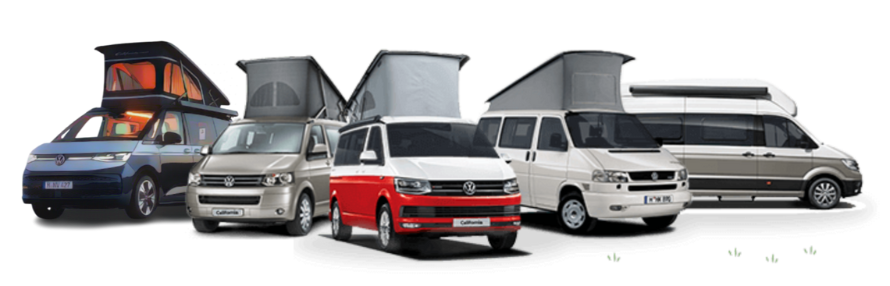
A complicating factor was the fact that Westfalia lost control of the VW conversion activities during the course of the bankruptcy. Because there was no longer any money for the necessary investments for the model switch from the VW T3 to the T4, the company, under the leadership of its former management, sold the machinery used for the T3 conversions to Volkswagen. Consequently, VW had the T3 ‘California’ produced at Westfalia-Werke as its own model. Until then, to create a Joker, the consumer would first order a suitable T3 from Volkswagen and then the desired camping equipment from Westfalia, although this could all be done in one go at the VW dealer. In this way, both partners benefited equally. After the sale of the machines: the transaction was henceforth handled by a single invoice. All margins for every sold t3 California went to Volkswagen, which paid Westfalia only a fixed amount for the conversion. As a result, Westfalia was henceforth merely a supplier. In this way, Volkswagen managed to save a considerable amount of money. That T3 California however, was sold without the possibility of options and made and sold as a whole but the Joker, also built in the same factory could be ordered with options. Consequently, the California was cheaper on the domestic market than Westfalia's only slightly higher-quality Joker and therefore sold much better. The T3 California was positioned more as an official VW model. The name California became a Volkswagen branding.
T4
One consequence of selling the machines was that there was money to develop a fine new campervan: the T4 California. We had one, and it is certainly a winner: slightly less interior space than the T3 campervan, but there is plenty of necessary trunk space.
With the new T4, VW continued this policy, and Westfalia remained for the T4 California, a contract manufacturer.

Daimler bought camper section
By then, however the 'three kings' were at the helm in Wiedenbrück, they had no knowledge of the industry and were looking for a suitable buyer. The VW Group would actually have been a logical choice, but one of the ‘three kings’ had ties with Daimler-Benz, where he sat on the Supervisory Board. Moreover, Westfalia was already building the Marco Polo. Therefore, it was proposed to Mercedes to expand the portfolio with a luxury motorhome division. They were receptive to the idea. However, this led to the splitting up of Westfalia, because Mercedes-Benz did not want to produce trailers and towbars and these divisions were eventually sold separately. Westfalia Mobile, the motorhome division, was first acquired by Daimler for 49 percent in 1999 and fully in 2001. Westfalia Mobile generated by far the largest revenue from orders from the VW Group. By then, this was being done with the California based on the T4. The takeover by the Mercedes-Benz parent company was not allowed to disrupt the cooperation with Volkswagen, because the head of Daimler's commercial vehicle division had previously forged the Transporter Union together with his college friend, head of VW Nutzfahrzeuge (Volkswagen Commercial Vehicles), in which the first Mercedes-Benz Sprinter and the second generation of the VW LT were built jointly at Daimler in Düsseldorf. But certainly not for their Transporter/Vito, like there is now a collaboration VW/Ford for the latest generation Transporter/Transit!
The T5
Meanwhile, the Volkswagen T5 was on the way. Westfalia, which had maintained a close relationship with VW for decades, was always informed years in advance about the ins and outs of an upcoming model. But since Westfalia was now a subsidiary of Daimler, Volkswagen distanced itself; it wanted to prevent Daimler from getting hold of information about the T5 – after all, this was a direct competitor to the Mercedes-Benz Vito. The Wolfsburgers therefore unceremoniously terminated the contract with Westfalia and built the T5 California in-house from then on at the van factory in Hannover.

I could now conclude with: the rest is history, but it is about Westfalia and eventually things are getting better for them.
Now, the company from Wiedenbrück has lost its most important customer. Although under Daimler's wing, not much could actually happen to the company, hundreds of employees at Westfalia immediately had to be laid off in 2003. Moreover, the parent company of Mercedes-Benz soon realized that the medium-sized camper company did not fit very well into the large-scale industrial structure of the group after all, so it started looking for a buyer from 2006.
Various interested parties came forward immediately, for before the VW split, Westfalia was the largest camper manufacturer in Europe. Employees from Knaus, Hymer, Trigano, Rapido, and many others came to view the company, but mainly to steal our know-how such as the production of pop-up roofs at Westfalia. Also numerous representatives of hedge funds walked through the halls. Ultimately, the choice fell on Aurelius. Yet they, too, did exactly what those kinds of buyers always do: ruin the company, extract a lot of money from it, sell the rights to the brand name to a dubious company in the British Virgin Islands, and monetize the vehicles from the factory museum in 2009. On top of that came an unfortunate model policy, including the Westvan, the first semi-integrated motorhome based on Ford, and the conversion of the Peugeot Expert into a camper.

From the former museum
Acquired by Rapido
Ultimately, Westfalia filed for bankruptcy in January 2010, after which the French camper brand Rapido acquired Westfalia. To do so, it had to buy back well-known brand names such as James Cook and Sven Hedin for a considerable sum of money. However, after the takeover by Rapido, a party with business acumen was finally at the helm again. That has paid off, as things have been looking uphill ever since and stability has returned to Westfalia. The OEM business is doing well, in other words, the conversion of vans commissioned by major brands that sell the campers under their own names, such as the Marco Polo for Mercedes-Benz and the Nugget for Ford.
A brand-new factory has been built in Gotha, Germany for its own product line with which the parent company Rapido aims to capitalize on Westfalia's good reputation. Furthermore, in the Vendée, France, the Westfalia models Kelsey, Kepler, and Jules Verne are designed and produced in the production plant of the Fleurette Brand which belongs to Rapido. Entirely in keeping with tradition, the Westfalia range today comprises only converted vans, now based on the Ford Transit and Tourneo, the Mercedes-Benz V-Class, Vito and Sprinter, the Volkswagen Transporter, the MAN TGE, and the Fiat Ducato.
Relaunch in America
The campers from Wiedenbrück were once regarded in the United States as an icon of German craftsmanship, but the brand disappeared from the market there a quarter of a century ago. The good reputation in America is now being used for a relaunch of the brand. The North American manufacturer Roadtrek will help circumvent the enormous import duties in force on vans and campers. This renowned van converter, based in Ontario, Canada, was acquired by Rapido six years ago. Unless Donald Trump raises the import duties applicable to goods from Canada, Roadtrek will start producing European-style Westfalia models based on the Ducato and Sprinter, even though this places the Wiedenbrück company even further away from the Prussian province from which it once derived its name. In conclusion, we can say that the group's golden age is long gone, but that the future looks brighter again under the wings of Rapido. Westfalia is nowadays effectively just one of many camper manufacturers. But one that benefits optimally from its excellent reputation and decades of experience.
Hopefully, it was fun and interesting to read

Greetings
Calibusje
Based on an article in AutoWeek magazine (shortened it a bit and rewrote a few things here and there) and supplemented with some Google finds.
Last edited: