beach 2nd leisure battery display query

  • Thread starter Neilsimpleflying
  • Start date
Neilsimpleflying

Neilsimpleflying

Messages
39
Location
leek staffs
Vehicle
T6.1 Beach camper 150
I have just fitted a second leisure battery to my 2022 Beach. Both are 75AH AGM batteries and are connected in parallel. The display shows 12.7v and both batteries also individually show 12.7v when checked with multimeter. My query is that the display has variously shown 4 minutes, 14 hours, and currently 42 hours at 1 amp. I don't understand this because 42 hours was indicated before when I only had one leisure battery. my simple brain says that two 75AH batteries connected in parallel should provide 150 AHs of power, i.e. 150 amps for one hour or 1 amp for 150 hrs? Allowing for the fact that the batteries should not be totally discharged, how much power have I actually got available?

Sorry if this sounds daft, but my knowledge of basic electrical theory was acquired a very long time ago!
 
I have just fitted a second leisure battery to my 2022 Beach. Both are 75AH AGM batteries and are connected in parallel. The display shows 12.7v and both batteries also individually show 12.7v when checked with multimeter. My query is that the display has variously shown 4 minutes, 14 hours, and currently 42 hours at 1 amp. I don't understand this because 42 hours was indicated before when I only had one leisure battery. my simple brain says that two 75AH batteries connected in parallel should provide 150 AHs of power, i.e. 150 amps for one hour or 1 amp for 150 hrs? Allowing for the fact that the batteries should not be totally discharged, how much power have I actually got available?

Sorry if this sounds daft, but my knowledge of basic electrical theory was acquired a very long time ago!
Hi NSF,

I don’t have the answer to your question,
I don’t have a T6.1 however I would assume the system will see one large battery at 12.7 volts rather than two. (Despite the actual capacity being increased with the addition of a second battery)

IMO The onboard monitoring system will only measure (see) the combined voltage at 12.7v & use this to calculate the indicated time, despite there being two batteries fitted (I.e. The combined voltage is still the same for both batteries despite the capacity increase, presumably the system works out the usable time based on voltage not capacity)

I would be very interested to hear how you fitted the second leisure battery and see some photos of the install?
 
I have just fitted a second leisure battery to my 2022 Beach. Both are 75AH AGM batteries and are connected in parallel. The display shows 12.7v and both batteries also individually show 12.7v when checked with multimeter. My query is that the display has variously shown 4 minutes, 14 hours, and currently 42 hours at 1 amp. I don't understand this because 42 hours was indicated before when I only had one leisure battery. my simple brain says that two 75AH batteries connected in parallel should provide 150 AHs of power, i.e. 150 amps for one hour or 1 amp for 150 hrs? Allowing for the fact that the batteries should not be totally discharged, how much power have I actually got available?

Sorry if this sounds daft, but my knowledge of basic electrical theory was acquired a very long time ago!
On the T6.1 , at least on the Ocean, each Leisure Battery has a Battery Monitor connection attached on the Black -tve pole monitoring the Battery status etc.
I presume when fitting the 2nd Leisure Battery you have not fitted this Battery Monitoring module.

I also presume you have wired the 2nd battery in parallel, as you stated, to the Red +tve pole of the original battery and the -tve lead either to a chassis Earth or to the Original battery -tve lead.
Either way, the Battery Monitor module on the original Leisure Battery and hence the Control Panel doesn’t see the 2nd battery. Function will be OK but the Control Panel will only see the Original battery.

IF you wire the 2nd battery -tve lead, DIRECTLY, to the the -tve pole of the Original battery, NOT to a chassis Earth or to the original Earth lead connection on the original battery then the Battery Monitor lead will then see a 12v battery with 150amp capacity.
 
For good advice you need to fill in the gaps:
  • New battery negative wired to ground or to the old battery negative? A photo or two would be helpful.
  • Battery ages?
  • Were the batteries balanced before fitting? How did you do that?
  • Were any fuses added?
You might try a reset of the battery sensor: unplug and replug the two pin plug on the square thing attached to the battery negative. After 3 hours with no charging or discharging the sensor should have a better idea of the battery state of charge.
 
hi guys thanks for the comments. This was fitted for me so cannot be sure but it looks as though the second battery -tve is connected to the original battery -tve. Original is OEM and the vehicle is 9 months old. Second battery is brand new. Original battery was fully charged (by alternator not EHU) and New battery trickle charged overnight before fitting. The only additional fuse fitted is an inline 15amp fuse for the Anderson connector for the fridge.
From what has been said it sounds as if the actual amperage available will be from both batteries but the monitor will only see one?

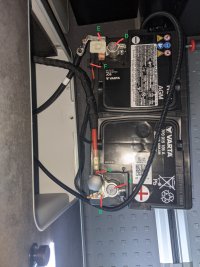
View attachment DSC_0754.JPG

View attachment DSC_0755.JPG
 
hi guys thanks for the comments. This was fitted for me so cannot be sure but it looks as though the second battery -tve is connected to the original battery -tve. Original is OEM and the vehicle is 9 months old. Second battery is brand new. Original battery was fully charged (by alternator not EHU) and New battery trickle charged overnight before fitting. The only additional fuse fitted is an inline 15amp fuse for the Anderson connector for the fridge.
From what has been said it sounds as if the actual amperage available will be from both batteries but the monitor will only see one?

View attachment 103906

View attachment 103907
Is the new battery same type and amp hours as the original?
 
From your photos it looks like the new battery is connected in parallel behind the battery sensor.

As fitted your sensor will probably perform poorly as the battery it sees will be double the capacity it expects. Internal resistance etc will be inaccurate and the sensor will have zero chance of gauging the battery state of health.

How to fix? Here are some options I can think of:

Rewire the new battery negative to chassis ground.​


Sensor will only see it's original battery, batteries should be even if in parallel. Simplest solution.

Reprogram the special vehicle unit with a battery capacity of 160Ah.​


No rewiring necessary. Battery capacity now correct but internal resistance etc will still be inaccurate.

Add a second sensor and reprogram the special vehicle unit exactly as if it was an ocean.​


Advantages: OEM setup. Disadvantages: expensive and fiddly.

Fuses:. This is a personal preference. For me I'd prefer fuses both ends of the parallel positive cable. But I've witnessed an in vehicle electrical fire. You certainly wouldn't see a large unfused cable in an aircraft even if jumping out was an option. If fused you need some strategy to detect a blown fuse.
 
The batteries are both AGM and 75AH. They are not the same make though. I take it the additional second sensor will be a VW part and consequentially horrifically expensive? How can I re-program the special vehicle unit? Yossarian, I absolutely concur in your view about large unfused cables and will be putting that right.
 
I take it the additional second sensor will be a VW part and consequentially horrifically expensive?
Probably around £50. You will also need to reprogram the special vehicle control unit. And run a data wire and make up the two pin plug.

How can I re-program the special vehicle unit?
Vcds in theory. Not many examples to follow though.
 
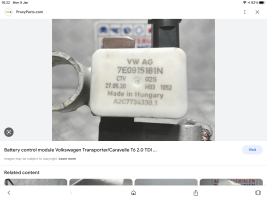
I think this is the OEM part (7E0915181N)


edit


6D10266A-F1C7-4668-A439-44957C06E8A8.png
 
I don’t think it is possible to re-program the Camping Control Panel using VCDS or any other OBD reader/coder.

This is of course presuming that the Control Panel between T6.1 Beach and T6.1 Ocean are exactly the same hardware and software with certain functions not enabled.
 
I don’t think it is possible to re-program the Camping Control Panel using VCDS or any other OBD reader/coder.

This is of course presuming that the Control Panel between T6.1 Beach and T6.1 Ocean are exactly the same hardware and software with certain functions not enabled.
Possibly not but the battery stats, as a single unit, are visible on the canbus, and there's a standard can module, from memory I think J1116 that appears to do all the heavy lifting in the camping department.

It would make sense to do it the automotive way.

Installing another sensor is not going to be an easy task. Moving the battery negative will be a lot simpler.
 
And it could be as simple as the if the LINBUS master sees battery no 3 then it works as a 3 battery van. Needs testing.
 
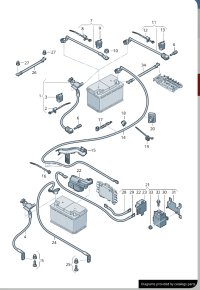
Here's the diagram

My memory is not the best. J1116 is the 3rd battery sensor. Of interest in the diagram is (pg 75/8)

J608 is the "special vehicle control unit" This appears to be what VW will fit to a California, a Taxi a police vehicle and and ambulance. It has CAN and LIN connectivity. It is the LIN master for the two rear battery sensors (or one in the case of a Beech)

The control panel, E153 is now a totally separate unit. It has CAN and LIN connectivity and appears to be the LIN master for the rear air conditioning fan etc.

J608 controls the inverter via LIN (75/7) (looks like the same bus as the battery sensors)

J608 controls all the various lights & monitors the buttons for lights. It also controls V36 which is labelled "coolant pump" but might just be the drinking water pump. (pg 75/10)

J608 controls the fridge (pg 75/12)

J608 senses the outside temperature and both water tanks. (Pg 75/13)

The vanity mirror cupboard is directly to 12v and the microswitch!

All the lights go through J608.

TLDR:

Almost all the heavy lifting is done by a unit called "special vehicle control unit" J608.
The control panel / E153 probably does most of its work by sending CAN instructions to J608 / BCM / Heater etc. It's low level function is to operate the rear a/c panel and fan.

It just occurred to me that various people reporting their dealers were swapping control panels to rectify various power faults were being taken for a ride. But I digress.

Screenshot_20230109-231433.png

Screenshot_20230109-231447.png

Screenshot_20230109-231528.png

Screenshot_20230109-231537.png

Screenshot_20230109-231634.png

Screenshot_20230109-224717.png
 
Thanks for all the replies and suggestions. It all looks a bit technical for me, but good to gain some further understanding. I have ordered a new 75amp cube fuse for the pos terminal on the new battery. I think I will go with the first and simplest solution of re-wiring the second battery negative to ground, which seems to be within my capabilities. Is it still worthwhile unplugging the monitor unit to see if it resets?
 
. Is it still worthwhile unplugging the monitor unit to see if it resets?
I don't think so. Because the installed battery is so much larger than the programmed one a sensor reset it's unlikely to improve matters.
 
Posiblemente no, pero las estadísticas de la batería, como una sola unidad, son visibles en el bus CAN, y hay un módulo CAN estándar, si no recuerdo mal creo que el J1116, que parece hacer todo el trabajo pesado en lo que respeta al camping.

Lo lógico sería hacerlo como en la industria automotriz.

Instalar otro sensor no será tarea fácil. Cambiar el polo negativo de la batería será mucho más sencillo.
No lo creo. Dado que la batería instalada es mucho más grande que la programada, es poco probable que reinicie el sensor mejore la situación.
hacer
Aquí está el diagrama

Mi memoria no es la mejor. J1116 es el tercer sensor de batería. En el diagrama es de interés (pág. 75/8).

J608 es la "unidad de control especial del vehículo". Al parecer, es la que Volkswagen instalará en un California, un taxi, un vehículo policial y una ambulancia. Cuenta con conectividad CAN y LIN. Es el controlador LIN principal para los dos sensores de batería traseros (o uno en el caso de un Beech).

El panel de control, E153, ahora es una unidad totalmente independiente. Cuenta con conectividad CAN y LIN y parece ser el controlador LIN principal para el ventilador del aire acondicionado trasero, etc.

El J608 controla el inversor a través de LIN (75/7) (parece ser el mismo bus que los sensores de la batería).

El J608 controla todas las luces y supervisa los botones correspondientes. También controla el V36, etiquetado como "bomba de refrigerante", aunque podría tratarse simplemente de la bomba de agua potable. (pág. 75/10)

El J608 controla el frigorífico (pág. 75/12)

El sensor J608 detecta la temperatura exterior y la de ambos depósitos de agua. (Pág. 75/13)

El armario del espejo de tocador está conectado directamente a 12 V y al microinterruptor.

Todas las luces pasan por J608.

Resumen:

Casi todo el trabajo pesado lo realiza una unidad llamada "unidad de control de vehículos especiales" J608.
El panel de control / E153 probablemente realiza la mayor parte de su trabajo enviando instrucciones CAN a J608 / BCM / Calefacción, etc. Su función de bajo nivel es operar el panel de aire acondicionado trasero y el ventilador.

Se me acaba de ocurrir que a varias personas que denunciaban que sus concesionarios cambiaban los paneles de control para solucionar diversos fallos eléctricos las estaban engañando. Pero me estoy desviando del tema.

View attachment 103926

View attachment 103927

View attachment 103928

View attachment 103929

View attachment 103930

View attachment 103931

 All this is correct, I installed the second battery in my VW California beach, following the official VW diagram in detail. At first the range did not change, because adaptation was necessary.
Gracias por todas las respuestas y sugerencias. Me parece un poco técnico, pero me viene bien entenderlo mejor. He pedido un fusible cúbico de 75 amperios para el terminal positivo de la batería nueva. Creo que optaré por la primera y más sencilla solución: conectar el negativo de la segunda batería a tierra, algo que parece estar a mi alcance. ¿Valdría la pena desconectar la unidad de monitorización para ver si se reinicia?

Here's the diagram

My memory is not the best. J1116 is the 3rd battery sensor. Of interest in the diagram is (pg 75/8)

J608 is the "special vehicle control unit" This appears to be what VW will fit to a California, a Taxi a police vehicle and and ambulance. It has CAN and LIN connectivity. It is the LIN master for the two rear battery sensors (or one in the case of a Beech)

The control panel, E153 is now a totally separate unit. It has CAN and LIN connectivity and appears to be the LIN master for the rear air conditioning fan etc.

J608 controls the inverter via LIN (75/7) (looks like the same bus as the battery sensors)

J608 controls all the various lights & monitors the buttons for lights. It also controls V36 which is labelled "coolant pump" but might just be the drinking water pump. (pg 75/10)

J608 controls the fridge (pg 75/12)

J608 senses the outside temperature and both water tanks. (Pg 75/13)

The vanity mirror cupboard is directly to 12v and the microswitch!

All the lights go through J608.

TLDR:

Almost all the heavy lifting is done by a unit called "special vehicle control unit" J608.
The control panel / E153 probably does most of its work by sending CAN instructions to J608 / BCM / Heater etc. It's low level function is to operate the rear a/c panel and fan.

It just occurred to me that various people reporting their dealers were swapping control panels to rectify various power faults were being taken for a ride. But I digress.

View attachment 103926

View attachment 103927

View attachment 103928

View attachment 103929

View attachment 103930

View attachment 103931

All of this is correct. I installed the second battery in my 2021 VW California Beach following the VW diagram. Initially, the estimated runtime didn't change because the J608 module required adaptation, but now it shows a runtime of >60 hours.

 
How did you Carry out the required adaptations?
 
How did you Carry out the required adaptations?
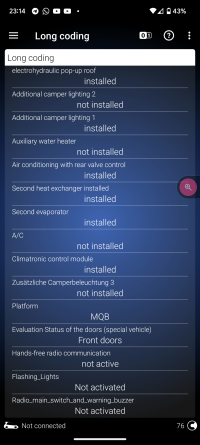
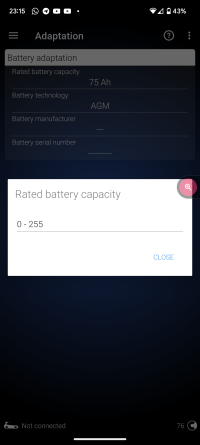
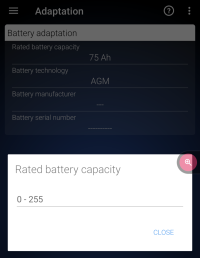
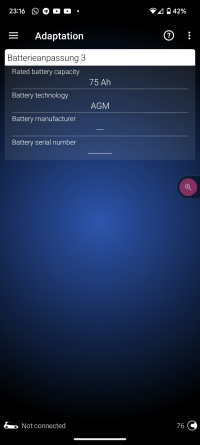
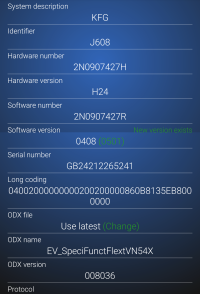
Use OBD11, you have to enter the taxi module, here is everything related to the camper van mode, there is a section for the third battery, capacity, battery type.
 
Back
Top