colintfcolintf
Top Poster
VIP Member
It fits in the cupboard under the sink without removing the shelf?it fits in cupboard or under the parcel shelf no problem.
If it does, that’s brilliant.



It fits in the cupboard under the sink without removing the shelf?it fits in cupboard or under the parcel shelf no problem.


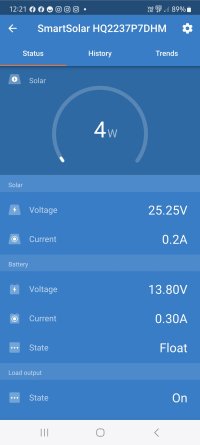
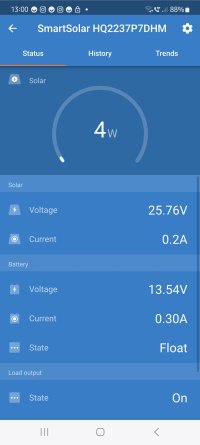
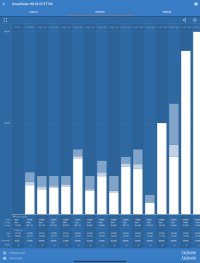
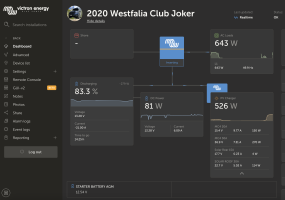
If it's on absorption or float you won't necessarily see the full power available from the panel. Absorption (to my knowledge at least) basically is a tapering from "full charge" to "float", so initially it'll be pushing in full power but as the voltage gets to the threshold for float, it'll taper the wattage down. Once you're on float, the wattage will only be what's needed to keep the batteries topped up. if you've no draw on the system, it does tend to show about 4W or thereabouts. Pop the 'fridge on to see it respond differently.Well the 100w panel is in place and wiring nicely fitted and app all working fine. Rogers instructions and those from @dspuk worked perfect and although it's now gone cloudy we had this reading and when sun came out for a second it was reading 26.5w! Very pleased.
View attachment 126833

Sorry for late replyHi - how have you wired the EF pack in to your solar charging set up?
So far, I’ve concluded a 12V female ciggie adaptor wired to the Victron load, in turn plugged into the EF with the 12V adaptor.
I’m sure there are other ways and interested to hear how others are setting it up.
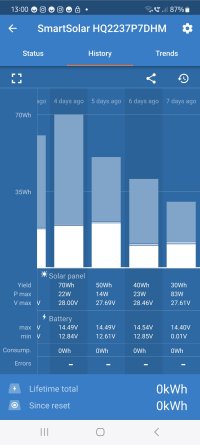
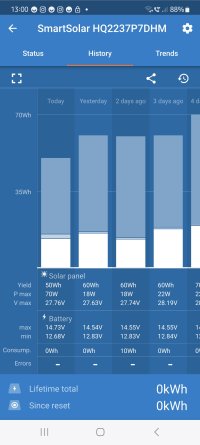

This is exactly my feeling; I got solar to give us flexibility but I hadn’t anticipated the comfort of (almost) limitless energy. How it performs in winter will be more interesting but we don’t tend to stay away for more than a few nights in winter so should be good.After a couple of years trying to decide whether or not to fit solar panels I took the plunge and last week had 2x100 panels fitted by @Roger Donoghue . First weekend away without EHU and I know we've had a rare bit of good weather but it was a nice feeling knowing that whatever juice the fridge and other bits consumed overnight would be replenished very quickly the next morning. Thanks again @Roger Donoghue !

Supply chain ethics are a massive and ugly rabbit hole unfortunately. Despite modern slavery statements and other such policies I expect the Cali itself will have materials on it with exploitation somewhere down the line.Just been sourcing for a PV project at home. I realise some might not be concerned about ethical aspects, and this is maybe a bit tangential to the thread topic, but for those who have an interest...
From my internet research is turns out that pretty much all panels from Chinese manufacturers make use of at least some raw materials and processing context in the Xinjiang region where very credible evidence exists of massive-scale forced labour and other human rights abuses, and the PV industry in China has made particularly extensive use of the 'commercial opportunities' that affords.
An excellent investigative report by Sheffield Hallam univ in 2021 is absolutely damning:
https://www.shu.ac.uk/helena-kenned...h-and-projects/all-projects/in-broad-daylight
From that and other googling I've concluded that the only way you can be (fairly) confident of not buying 'exposure' to the human rights abuses in Xinjiang is to buy panels made by certain non-Chinese companies that have done a decent job of verifying their supply chains. One such is Meyer Burger, another is REC.
I don't know what options are available for van-sized panels but thought the above might be of interest at least to some folks.


Just been sourcing for a PV project at home. I realise some might not be concerned about ethical aspects, and this is maybe a bit tangential to the thread topic, but for those who have an interest...
From my internet research is turns out that pretty much all panels from Chinese manufacturers make use of at least some raw materials and processing context in the Xinjiang region where very credible evidence exists of massive-scale forced labour and other human rights abuses, and the PV industry in China has made particularly extensive use of the 'commercial opportunities' that affords.
An excellent investigative report by Sheffield Hallam univ in 2021 is absolutely damning:
https://www.shu.ac.uk/helena-kenned...h-and-projects/all-projects/in-broad-daylight
From that and other googling I've concluded that the only way you can be (fairly) confident of not buying 'exposure' to the human rights abuses in Xinjiang is to buy panels made by certain non-Chinese companies that have done a decent job of verifying their supply chains. One such is Meyer Burger, another is REC.
I don't know what options are available for van-sized panels but thought the above might be of interest at least to some folks.
Interesting and useful, many thanks. I was aware that the US enacted legislation recently to attempt to ban imports of Xinjiang-sourced solar, which will doubtless have boosted US producers. I'm waiting for my prospective installer to come back with options, I've told them I'm not prepared to take Jinko, or any other Chinese panels.Last year Meyer were struggling financially
so be a bit cautious as regards warranty before splashing the cash. Think they shifted manufacturing to US (from Germany) to reduce costs and increase sales.

Interesting and useful, many thanks. I was aware that the US enacted legislation recently to attempt to ban imports of Xinjiang-sourced solar, which will doubtless have boosted US producers. I'm waiting for my prospective installer to come back with options, I've told them I'm not prepared to take Jinko, or any other Chinese panels.
Solar panels made in Singapore
Come inside and discover the high automation of REC production and the measures we take to deliver product quality beyond expectations.www.recgroup.com

And herein lies the problem; like the root system of a tree, a final product often has so many different branches in it's supply chain history. Even something "relatively" simple like a steel bolt will have transport, machine shops, foundries, mining, transport and other raw materials, involving probably at least dozens of companies if not more, many of which will be in parts of the world where legislation isn't in place (or is ignored) to control how "workers" (read: borderline slaves in some places) are treated.Interesting as Singapore does not have any raw materials of its own, it’s a trading post, so wonder where the raw material is sourced.
Sheffield Hallam say REC panels, apart from one product line now discontinued, have a low risk of containing XUAR material:Interesting as Singapore does not have any raw materials of its own, it’s a trading post, so wonder where the raw material is sourced.

 www.windandsun.co.uk

Sheffield Hallam say REC panels, apart from one product line now discontinued, have a low risk of containing XUAR material:
Solar Panels and Chinese Forced Labour
Recent reports have raised the concern that many UK solar projects and some of the world’s biggest solar companies use silicon that originates in China’s oppressed Xinjiang region, with a high possibility that forced labour has been used in its production.
That was last year, one hopes they have maintained their sourcing policy. I read somewhere else that REC has just re-started sourcing polysilicon from within the USA. Of course, who knows what will happen if a Trump administration starts a tariff war next year.
RockinNRollin points out the more general issues around various ethical sourcing dimensions in very complex products like a vehicle. But here we're talking about a specific product, ie solar panels and it seems to me if you buy Chinese brand panel you are almost certainly buying Xinjiang-sourced polysilicon. While with non-Chinese makes, if chosen carefully, that risk is very much lower.
You could already charge your ecoflow with the 12V socket in the back right ?I now use to charge my ecoflow Delta 2 using the output from the mppt controller (you can set the mppt to only turn on output when battery v is in optimal range and turn off when lowish).

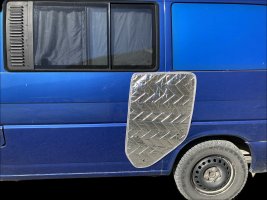
Your fridge should not consume that much power, unless the van side is in full sun 36c is hot but doable just! See picture I saw similar at Amersfort VW in NL used a cab winds reflective with magnets, helps a lot my T4 I’ve have fully stripped and fully insulted, but behind the fridge is limited due to lac of space.So, after two weeks in Italy, here is some pespective. We have a Waeco CFX28 fridge running from the load port of our Solar charger so we can see how much it draws. We have two 120w panels on the roof and a foldable 100w panel which really gives us 100w. Our camp spot, as usual here in Italy, is somewhat covered with olive trees. We could manage three days on spot in Iseo with some faffing around with the foldable but could not have managed more. Battery close to 12.2v unloaded so fridge shut off itself. After three days in Levanto with lots of tries with the foldable with one of the roof panels in parallel we just gave up and connected to 230v. Battery was never charged. It was 12 days ago. Lithium would not haved saved us, nor would three panels on the roof either. We have managed very fine in Sweden for weeks before without 230v, but the fridge just takes too much power when its 36-26C degrees 24/7.
View attachment 127080

correct but you cannot control the on / off based on leisure battery vYou could already charge your ecoflow with the 12V socket in the back right ?
solar => leisure => 12v => ecoflow
Does the foam rubber come with the self install kit, or something that Roger fitted for you?At the rear.
BTW Roger Donahue fits a foam rubber infill between the roof and underside of the panels to stop wind getting underneath them.
View attachment 125591
Does the foam rubber come with the self install kit, or something that Roger fitted for you?
Super. Thank you.The panels come supplied with foam already stuck to the bottom of the fixing frame













The VW California Club is the worlds largest resource for all owners and enthusiasts of VW California campervans.