
The Merle
4x4 joker
Super Poster
Lifetime VIP Member
That will be a lazy dealer VAT mistake they do them all the time



That will be a lazy dealer VAT mistake they do them all the time


It's going to be a very challenging time for some in the near future; many (myself included as I got my first mortgage in 2012) are used to very low interest rates which has softened the impact of explosive house prices. While there is a slight taper in house prices, it isn't compensating for the interest rate jumps, so as mentioned above, those on very low rates taken out in the last 2-3 years will be hitting some marked changes. The situation is worsened for those stretched and I know from personal experience that lenders almost encourage mortgages that are really too much of a financial burden (from memory, they will tell you how much your repayments would be if rates climbed to X%, but until recently I suspect most people who haven't had mortgages prior to the financial crisis would never imagine it would happen). It doesn't help that a worrying proportion of people don't understand the basic mathematics of interest rates, assuming a 2% jump in their rate equates to a 2% jump (or a similar nominal figure) in their repayments.
It's all a bit of a mess. Cali's are luxury good really though, but ones that are multi-purpose (i.e. daily transport as well as their leisure capacity). I suspect that will work in their favour and unless the "staycation" bubble bursts (unlikely given air fares are only going one way) I think their residuals will be strong for as long as there isn't something overly restrictive on ICE vehicles.
The UK has never really been ZIRP though (although we did get close); property prices were increasing fairly quickly even before interest rates plummeted; since the 70s, barring temporary dips in the late 80s and late 00s for obvious reasons, the overall trend has been upwards with inflation-adjusted house prices doubling roughly every 20 years. I think a strong housing demand partly driven by a (slowly) growing population will probably continue to fuel resilience and growth in property prices in the long term. The only thing likely to reverse this would either widespread unaffordability (by this, I mean literally swathes of property unaffordable to sufficient numbers that they won't sell) or a significant shift in housing demand (unlikely unless the govt decides to build a million council houses).It’s the other way round. ZIRP has caused the explosion in house prices. The end of ZIRP will bring them back down again. It’ll just take a little time to filter through as motivated / forced sellers become more commonplace over the coming months / years as ultra cheap mortgage deals end.
The UK has never really been ZIRP though (although we did get close); property prices were increasing fairly quickly even before interest rates plummeted; since the 70s, barring temporary dips in the late 80s and late 00s for obvious reasons, the overall trend has been upwards with inflation-adjusted house prices doubling roughly every 20 years. I think a strong housing demand partly driven by a (slowly) growing population will probably continue to fuel resilience and growth in property prices in the long term. The only thing likely to reverse this would either widespread unaffordability (by this, I mean literally swathes of property unaffordable to sufficient numbers that they won't sell) or a significant shift in housing demand (unlikely unless the govt decides to build a million council houses).
I get that and agree it fuelled a particularly steep increase in values, but average BOEBR has been around 7% over the very long term and said previously there's still overall growth in prices even adjusted for inflation; we're still not up at that long term average rate yet, so I think there may be a temporary shrinkage in values while the market stabilises in reaction to rate changes etc.., then it'll find its feet and prices will creep upwards again (albeit far more slowly than over the last 10 years).We’ve had well over a decade of ultra low rates / ZIRP, and all the QE. Remember, they were supposed to be emergency interest rates following the financial crash in 2009. Maintaining these emergency rates is what’s pumped up asset prices. Now it’s ending, asset prices will adjust accordingly.
I get that and agree it fuelled a particularly steep increase in values, but average BOEBR has been around 7% over the very long term and said previously there's still overall growth in prices even adjusted for inflation; we're still not up at that long term average rate yet, so I think there may be a temporary shrinkage in values while the market stabilises in reaction to rate changes etc.., then it'll find its feet and prices will creep upwards again (albeit far more slowly than over the last 10 years).
We’ve had well over a decade of ultra low rates / ZIRP, and all the QE. Remember, they were supposed to be emergency interest rates following the financial crash in 2009. Maintaining these emergency rates is what’s pumped up asset prices. Now it’s ending, asset prices will adjust accordingly.

Don’t worry to much about us BTL landlords. We can sell up without losing our homes.(actually, 5 is game over for many, particularly over leveraged landlords with no resilience).
Don’t worry to much about us BTL landlords. We can sell up without losing our homes.
I think few have expanded their portfolios since the chancellor slapped a 3% stamp duty surcharge on second homes and investment properties in 2016. Price rises 2016 to 2023 are likely to exceed any price drops.
A flat I bought in 2012 for £130,000 (£78,000 mortgage; £52,000 equity) is now valued at £300,000 (£78,000 mortgage; £222,000 equity), a quadrupling in equity.
In that time I’ve paid about £20,000 in mortgage interest, about £20,000 in maintenance, £5,000 in insurance and received about £145,000 in rent.
All true and meanwhile governments fanning the house price fire with help to buy schemes and stamp duty holidays.
Don’t worry to much about us BTL landlords. We can sell up without losing our homes.
I think few have expanded their portfolios since the chancellor slapped a 3% stamp duty surcharge on second homes and investment properties in 2016. Price rises 2016 to 2023 are likely to exceed any price drops.
A flat I bought in 2012 for £130,000 (£78,000 mortgage; £52,000 equity) is now valued at £300,000 (£78,000 mortgage; £222,000 equity), a quadrupling in equity.
In that time I’ve paid about £20,000 in mortgage interest, about £20,000 in maintenance, £5,000 in insurance and received about £145,000 in rent.
Of course. High house prices win elections. Falling house prices lose them. They’ll do anything they can to keep the plates spinning. If we start seeing mass foreclosures, some sort of ‘rescue scheme’ wouldn’t surprise me. All of which further encourages people to borrow to the max if ultimately there’s a bail out should they hit trouble.
As I said, the over leveraged with no resilience. Plenty of those around. They have to find cash every month to pay the hugely increased mortgage when the rent could be considerably lower. I’m a landlord too, but unleveraged, so very happy for landlords to leave the market and reduce supply. It’s going to get quite ugly IMHO.
Yes, you can sell without losing your home, but let’s not forget that the tenants in your houses will lose theirs if you sell.Don’t worry to much about us BTL landlords. We can sell up without losing our homes.
I think few have expanded their portfolios since the chancellor slapped a 3% stamp duty surcharge on second homes and investment properties in 2016. Price rises 2016 to 2023 are likely to exceed any price drops.
A flat I bought in 2012 for £130,000 (£78,000 mortgage; £52,000 equity) is now valued at £300,000 (£78,000 mortgage; £222,000 equity), a quadrupling in equity.
In that time I’ve paid about £20,000 in mortgage interest, about £20,000 in maintenance, £5,000 in insurance and received about £145,000 in rent.

But my point is how many BLT landlords are over leveraged, given the 3% stamp duty surcharge introduced in 2016 almost killed off new investment purchases?
In February 2014 (last time I bought an investment property) I had £745,000 of mortgage debt and an estimated 45% equity.
Today I have £290,000 of mortgage debt and an estimated 89% equity.
I expect most BTL landlords are in a similar position having both reduced debt and benefitted from rising house prices.
By slapping on that 3% surcharge George Osbourne has (inadvertently) done BTL landlords a huge favour.

Latest update… price crash:
March 2017 (new) £42,222
March 2018 WBAC £28,730
March 2021 WBAC £30,315
May 2021 WBAC £34,505
July 2021 WBAC £37,270
August 2021 WBAC £36,150
October 2022 WBAC £23,810
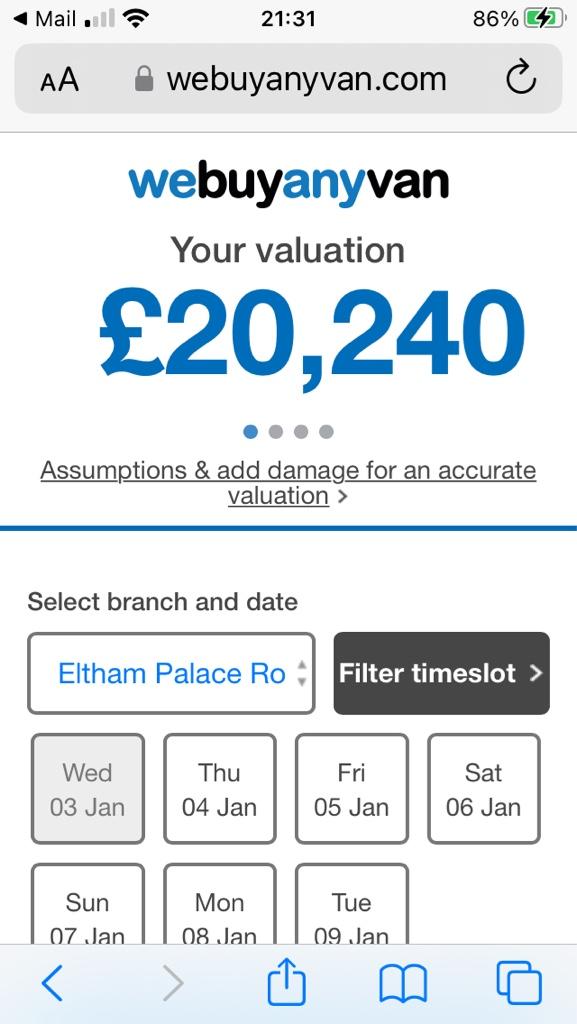
High mileage. We’ve done 85,000 miles.WBAC = £20,240
Cheapest T6 Cali = £38k
Something is not adding up!

That looks about right for an illiquid market.New Year update
March 2017 (new) £42,222
March 2018 WBAC £28,730
March 2021 WBAC £30,315
May 2021 WBAC £34,505
July 2021 WBAC £37,270
August 2021 WBAC £36,150
October 2022 WBAC £23,810
January 2024 WBAC £20,240

7 years old in March 2024?High mileage. We’ve done 85,000 miles.

Up and down like a something somethingsWith cars depreciating at a rate not seen for years, WBAC are only prepared to buy a bargain.
I’m sure it’ll be 25k again in a few months once things have settled.












The VW California Club is the worlds largest resource for all owners and enthusiasts of VW California campervans.



 …


